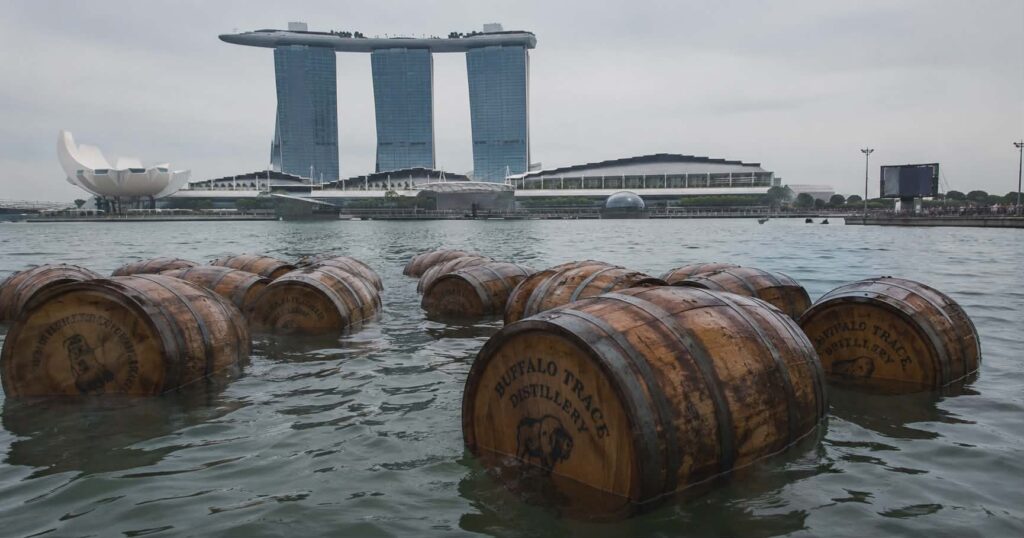
If you work in the drinks trade in Singapore, here’s a piece of news worth paying attention to: American whiskey is actively being redirected to our market, and the reasons behind it say a lot about where the global drinks industry sits right now.
This isn’t just an interesting footnote. It’s a genuine shift and Singapore is right at the centre of it.
So what’s actually going on?
The short version: American distillers are having a rough time in their traditional export markets, and they need new ones. Fast.
Canada — historically one of the most reliable and important markets for American whiskey — has pulled US spirits from retail shelves in response to ongoing tariff disputes. A market that was once a given is now, for all practical purposes, closed. Michael Bilello, President and CEO of the American Whiskey Association, said it plainly at a trade event here in Singapore in April, ‘Canada is essentially shut off’ Full stop.
Europe isn’t much better. Even before any formal retaliatory measures landed, the constant threat of tariffs made forward planning close to impossible for producers trying to manage inventory and cashflow across long supply chains.
And back home in the US, softer consumer spending and a slowdown in domestic demand have left a significant amount of stock sitting in warehouses with nowhere to go.
The numbers are pretty stark.
- Overall American spirits exports dropped 3.8% in 2025 to $2.37 billion
- Exports to Canada fell by a staggering 85% in Q2 2025 alone
- American whiskey exports to the EU dropped 35% to $454 million
- Since 2012, American whiskey inventories have nearly tripled — reaching close to 5.7 billion litres by end of 2024, against domestic and export sales of just over 378 million litres combined
That is an enormous amount of bourbon looking for a new home.
Enter Singapore...
US distilled spirits exports to Singapore hit $27 million in 2025 — up 42.6% from the year before. That’s not a rounding error. That’s a deliberate pivot.
The reason Singapore makes sense is straightforward. Under the long-standing US-Singapore Free Trade Agreement, Singapore applies zero tariffs on American whiskey. In a global environment where tariff policy can change overnight, that kind of certainty is genuinely valuable to any producer trying to plan ahead.
But beyond the trade policy, Singapore is simply a great market for this category. It’s high-spending, sophisticated, and has a bar and hospitality scene that genuinely champions American whiskey — from well-poured bourbon highballs to allocated single barrel releases. The audience is here. The infrastructure is here. The enthusiasm is absolutely here.
But here’s the angle that doesn’t get talked about enough.
Singapore isn’t just a destination market for American whiskey, it’s a gateway.
This is one of the most important re-export hubs in the world, and the drinks trade is no exception. The numbers tell the story perfectly: in 2023, Singapore imported $2.1 billion worth of spirits and exported $2.5 billion. Read that again, it exported more than it imported. That’s not a consumption story. That’s a distribution story.
Singapore sits at the centre of a regional network that stretches across Indonesia, Vietnam, Malaysia, Thailand, the Philippines and beyond, markets that are growing fast, increasingly affluent, and developing a serious appetite for premium Western spirits. Getting product into Singapore isn’t just about selling it here. It’s about using Singapore as the launchpad to reach the rest of Southeast Asia.
For American distillers, that changes the maths considerably. A $27 million export figure to Singapore sounds modest on its own. But when you factor in what gets redistributed from here across the region, the real opportunity is significantly larger than that number suggests.
Singapore’s world-class port infrastructure, bonded warehouse facilities, free trade zones, and established logistics networks make it one of the most efficient places in the world to stage and distribute product across Asia. It’s why so many global drinks brands have their regional headquarters here. It’s why Vinexpo Asia chose Singapore as its Southeast Asia home. And it’s increasingly why American distillers looking for a foothold in Asia are pointing their shipments this way.
Getting into Singapore is one thing. Using Singapore properly, as the regional platform it genuinely is another thing entirely. The brands that understand that distinction will be the ones that win in this market.
What does this mean for the trade?
If you’re working in distribution, retail, or hospitality, it’s worth thinking through what this shift actually means on the ground:
- More American whiskey coming to market — expect broader range, more labels, and expressions that haven’t traditionally made it to Singapore
- Distributors will be approached — producers sitting on inventory and hunting new markets tend to move quickly and come to the table with attractive commercial terms
- Pricing may become more competitive — more supply chasing the same shelf space usually has that effect
- Bartenders should be excited — more variety and potentially better access to allocations that were previously hard to get hold of
- Regional players should be paying attention — if you’re operating across Southeast Asia, the window to secure good American whiskey partnerships through Singapore is open right now
The bigger picture.
What this story really highlights is how quickly the global drinks trade can be reshaped by forces that have nothing to do with what’s actually in the bottle. Trade disputes, tariff policy, and geopolitical tensions are now as critical to a distillery’s export strategy as their recipe or their ageing process.
Singapore – a stable trade environment, strategic regional position, genuinely passionate drinks market. Currently is looking like one of the smartest places in the world to be selling premium spirits right now.
American whiskey is heading our way. And from where we’re standing, that sounds like very good news.
Working in distribution, retail, or hospitality and already starting to see this shift? We’d love to hear what you’re seeing on the ground — reach out or write for us.