
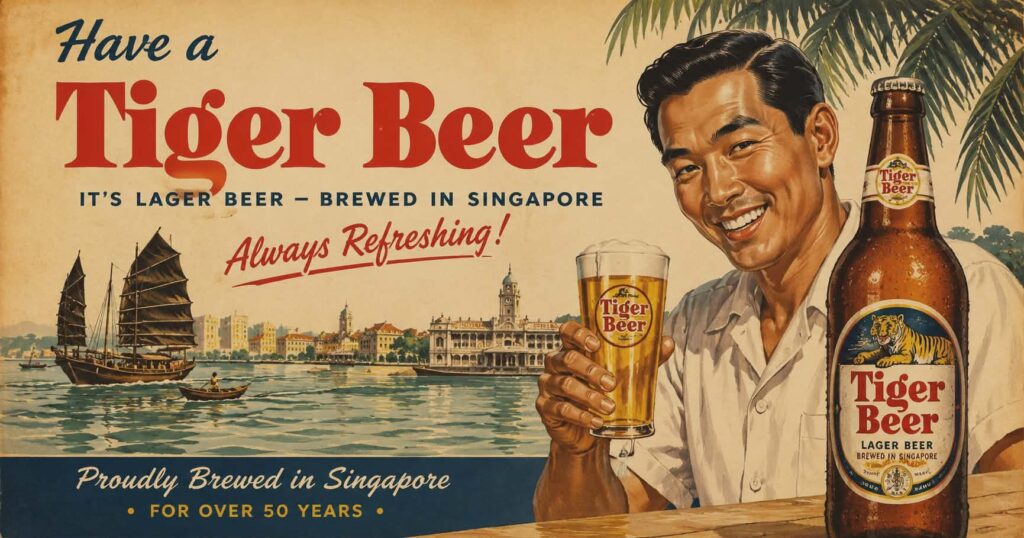
Tiger Beer Is Leaving the Tank — And It Means More Than You Think
I’ll be upfront, this one’s a little personal. Beer is my drink of choice, and Tiger has been part of the fabric of this industry for as long as most of us can remember. So when news broke that Heineken is gradually moving Tiger Beer’s production out of Singapore, it hit a little differently.
But let’s talk about what’s actually happening, because it’s worth understanding properly.
A bit of history first.
Tiger Beer has been brewed in Singapore since 1932 — making it one of the oldest and most recognisable homegrown names on the island. It was first created through a joint venture between Fraser & Neave and Heineken, and went on to become one of Asia’s most iconic lager brands. That’s nearly a century of local brewing heritage. Not nothing.
Heineken’s decision to shift production to regional facilities in Malaysia and Vietnam means Singapore will no longer be home to large-scale brewing. The island will remain the global brand headquarters, strategy, marketing, commercial direction all stay here, but the actual liquid? That’s moving out.
On paper, it’s an operational efficiency call. Lower costs, centralised production, regional scale. Completely logical from a business perspective.
But in reality, it feels like the end of something.
And here’s the wider truth it points to.
This isn’t just a Tiger story, it’s part of a much bigger global trend. Brewing is consolidating. The days of every major market having its own production facility are quietly disappearing, replaced by regional mega-breweries built for efficiency and scale. It’s happening across Europe, it’s happening across Asia, and Singapore is simply the latest chapter in that story.
What Singapore is becoming and this is the interesting part, is a regional control centre. Brand management, logistics, commercial strategy, market development. The decisions that shape how beer is sold and positioned across Southeast Asia are increasingly being made here, even if the beer itself isn’t being made here.
Which raises a question that I suspect we’ll be debating for years:
Is “local beer” defined by where it’s brewed — or where it’s built?
Increasingly, the industry is leaning toward the latter. And honestly, there’s a reasonable argument for it. But it’s a shift worth acknowledging, not just accepting quietly.
One last fact that puts it all in perspective:
Tiger Beer is currently brewed in 11 countries globally, from the UK to Thailand to Australia. Soon, that number drops to 10. Singapore, where it all started, won’t be one of them.
That’s a strange thing to sit with over a cold quart at Newton Circus. But here we are.
What do you think — does it matter where a beer is brewed, or is the brand what counts? We’d genuinely love to hear from the trade on this one. Drop us a line or write for us.